Thursday, June 7, 2012

Rich or Poor?


Austria Tours

Compared to the rest of the world, Austria is a very rich nation. In ranking, Austria is the seventh richest country in the world per capita. They also have an extremely low unemployment rate at 6.7%, much lower than other European countries such as France and Italy, with rates around 12%.  Austria’s economy is not as strong as Russia, Brazil, China, India or Mexico, but Austria’s citizens have a higher standard of living and jobs with first-rate working conditions. Also Austria's economy is versatile. It does not just focus on a few things to produce but sectors of production, such as their food industry, tourism, finance, timber industry and new technologies (Austria Economy Profile 2012, 2011). This versatility and having a well-based economy has allowed Austria to become very rich, not only in economics but in all other aspects as well.  

Living Conditions


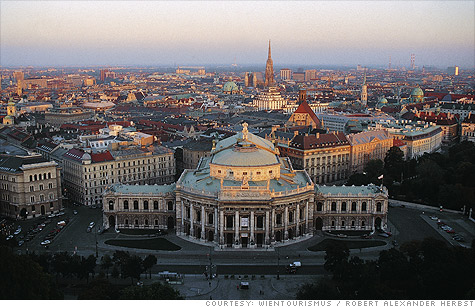
The living conditions in Austria are excellent. The secret for Austria is that they live simple lives, but learn to love and make the best out of it (Living in Austria, 2012). Vienna, the capital city of Austria, currently is the number one city for the best quality of living, according to Mercer’s influential annual survey. Vienna offers political stability and has a low risk of terror acts. Also the Austrian lifestyle is one of high quality and in order to keep pace with this high standard of living, the country offers abundant opportunities for various kinds of employments, those that ensure a better lifestyle. The country even encourages the setting up of individual businesses for a higher living standard for the individual (Vienna has the best standard of living in world, 2009). These factors have boosted Austria’s standard of living and allowed the people to enjoy their lives and has added to the success of Austria as a country. 


Foreign Affairs


In 1955, Austria’s foreign policy was neutrality, as agreed with the Four Powers that year. They have passed an amendment to their constitution that states that they will forever remain neutral. But to the Austrians, neutrality means something a little bit different. That same year, Austria joined the United Nations and took sides with the community of democratic nations. However, they believe that this will not impede with their plans to never join any military alliances or allow foreign troops to be stationed on their soil. Another important part of Austrian foreign policy is internationalism. Austria is part of many international organizations including the UN and its subsidiary agencies. With these organizations they help with peacekeeping operations. They have been in Cyprus, Egypt, and Israel to help bring about peace. Also during the Cold War, Austria was an active participant in easing the tension between the United States and the Soviet Union. Austria’s leaders have pursued these policies because helping others stay at peace helps them stay neutral (Austria Foreign Relations, 1993). If there is no war, there is no need to take sides. Austria’s policies of neutrality and internationalism have worked very well for them and have added greatly to their success.

Global Economy


Austria’s own economy is a thriving market economy that has provided its’ people with a high standard of living. However, it is not an economic super power that dominates all global trade like the United States or China. Austria has many exports that are in high demand. These include: machinery and equipment, motor vehicles and parts, paper and paperboard, metal goods, chemicals, iron and steel, textiles, and foodstuffs. Every year Austria provides about $150 billion dollars in exports to the global economy, especially its main trading partners: Germany, Italy, Switzerland, France, and the Czech Republic, as well as the United States and Russia. Also during the international financial crisis and global economic downturn in 2008 there was a recession and many of Austria's largest banks faced large losses. However, the government was there to provide support for the banks as well as implement reforms to make the Austrian economy better and stronger (Austria Economy Profile 2012, 2011). By helping their own banks take care of their problems quickly, the Austrian government allowed their country to get back to the global economy and on the road to success.

Problems


The current problems facing Austria are relatively few and mostly environmental and energy-based. Austria has a great need for fossil fuels and natural gas, however these essentials have escaped their grasp for many years. It is not that Austria does not have them at all, it is that their supply is far below their needs. Also air pollution, acid rain and wetland depletion are major problems for Austria. Only 10% of Austria’s original wetlands sill exist, they other 90% has been destroyed or severely damaged due to human activity. Deforestation is another problem of Austria. The once large forests of Austria are now not so large and 85% of the forest that is not cut down is reserved and scheduled for future timber harvests (Katz, 2006) 

Problem Solving


To solve the lack of fossil fuels and natural gas, the Austrian government has created plans and restrictions such as the Regional Energy Action Plan. For the air pollution, Austria has been inventing new technologies that produce energy in a more environmentally friendly way. Things such as wind turbines have replaced many of the power plants in Austria. With wetland depletion it is all about getting the word out to the people about the issue. Also, The government is promoting public awareness of all of the environmental and energy issues of Austria to try to get the people to do what they can to help (Katz, 2006).

Success or Failure?


In the near future my country will be a success. They have so much going for them: a strong economy, excellent trading partners, a high standard of living, a high unemployment rate, they have an extremely rich culture and are a relatively happy people. They have achieved so much since the end of WWII and have changed from night to day. I mean once they were a large part of the Nazi force and now they are active participants in peace keeping throughout the world and friendly to countries wishing to join them. This will help them continue to grow as a country in their government, culture, science and technology, and their government and add to the already success of Austria.